edited collection
Edited by Tessa Lewin and Olu Jenzen
call for contributions
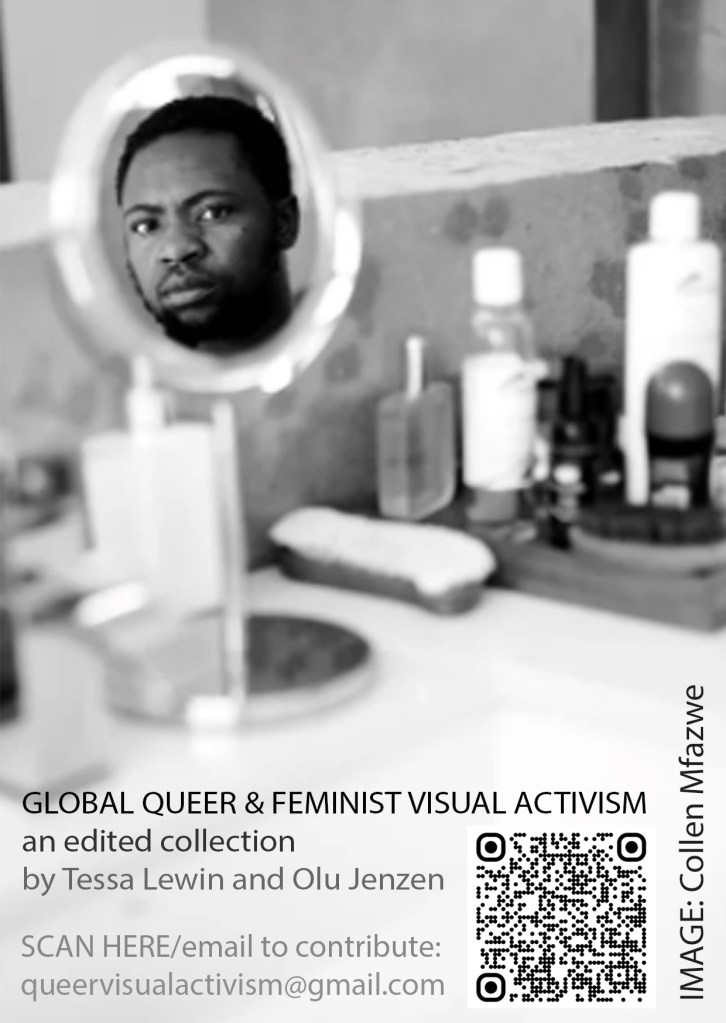
about the edited collection
Visual communication is intertwined with sexual and gender rights movements from its early days, and both subcultural and popular cultural visual repertoires have emerged in tandem with feminist and queer political work for sexual liberation. The epistemology of LGBTQ+ liberation is arguably as entwined with ‘visibility’ as with ‘pride’, and the state of being visible, being ‘out’ remains a major (albeit fraught) trope in queer culture and activism. In different cultural and political contexts across the globe, feminist and sexual rights movements have produced specific aesthetics. Across the globe, the 21st century has seen new emerging and revitalised forms and uses of visual activism. Alongside the numerous regressive social changes that we have experienced in recent times, we have also seen the emergence of a vibrant visual landscape which mobilises the visual form for political resistance. While activist expressions and artefacts are manifestly visible, other aspects of visual activism -such as the relationships built and sustained through this work – remain unseen. The edited collection is interested in the queer and feminist social justice activist opportunities and expressions across images and their context of production, mediation and re-mediation, as well as both the aesthetics and performativity of visual activism.
This volume engages with a range of visual cultures. Visual activism, as we seek to explore it, is not limited to art activism but rather encompasses a wide range of visual expressions and forms of activist creativity. This includes, but is not limited to, queer and feminist craftism, activist filmmaking, graphic design, memes, visual social media and vlogging, graffiti, fashion, and other forms of visual interventions and cultural jamming.
We seek to bring together scholars across the arts, humanities and social sciences to examine a range of approaches to and examples of ‘queer and feminist visual activism’, including the iconography of feminist and LGBTQ+ movements, visual social media, and the performative nature of images in activism, but also paying particular attention to cultures of activist practice that surround the production and (re)mediation of images and the work the visual does that is not seen.
We situate queer/feminist visual activism within the contemporary landscape of anti-gender mobilisation/backlash, and as a form of resistance to this politics, and within this form, recognise three overlapping categories – resisting, surviving and creating queer/feminist futures (Faith et al. 2024) – which will form the structure of the edited collection.
Resisting is about naming backlash, refusing its terms, and actively disrupting its effects in the present. It includes strategies that directly push back against backlash, for example, by confronting anti‑gender narratives, mobilising collective protest, and challenging regressive laws, policies or institutions. Surviving recognises that when repression intensifies, staying alive, staying connected, and avoiding burnout are themselves political achievements. It captures practices that sustain people and movements under conditions of backlash, including care, protection, safety planning, and emotional/collective resilience. Creating feminist futures is about building alternative visions, practices and institutions that prefigure the worlds we want beyond backlash. This includes speculative imaginaries, experimental organising, and creative work that opens up more just, joyful and liberated feminist and queer futures rather than merely reacting to the present.
We invite theoretical and empirical contributions from across disciplines, and from different contexts and geographical settings, addressing feminist, trans and queer visual activism in relation to—but not limited to:
- Political visual communication
- The politics of visibility
- Trans in/visibility
- Production, mediation and re-mediation
- Digital activism
- Public spaces and institutions
- Street art
- Film and Photography
- Performance
- Craft
- Protest and direct action
- Pride events
- Bodies
- Material cultures of activism
- Aesthetics and form
- Visual narrative
- Fashion and fibre art
- Everyday activism
- Activist coalitions
- Backlash
- Activism in the Global South
- Crip / queer disability activism
- Race and ethnicity
- Intersectionality
- GLAM policies and curating
- Queer and feminist archiving
- Popular culture
- Strategic communication
- Cultural jamming
how to submit
Please send abstract (max 500 words) and short biographical note (max 150 words) to queervisualactivism@gmail.com
Deadline for Abstracts: 1 June 2026
Notification of Acceptance: July 2026
Full Chapter Deadline: 1 December 2026
Word Count for Abstracts: 500 words
Planned publication: 2027/28
Publisher: TBC
Length: 7,000–8,000 words (excl references)
Referencing Format: APA
 Olu Jenzen